Company
WE BUILD SYSTEMSTHAT SURVIVEREAL ENVIRONMENTS.
- Type
- Product company
- Based
- Pakistan / Remote
- Live products
- One

Thesis
The gap is not model quality
The AI landscape is well supplied at both ends. There are labs building excellent foundation models, and there are firms willing to build you a demonstration of almost anything.
What is scarce is the middle: companies that take a model, wrap it in the ingestion, reasoning, constraint and observability machinery a real deployment needs, and then stay accountable for the result while it runs.
Most systems that fail in production do not fail because the model was not clever enough. They fail because nobody engineered what happens after the model answers.
That is the work we chose. It is less glamorous than model research and considerably less profitable than selling development hours, and it is the part that determines whether an AI system is worth trusting with a decision that matters.
Origin
It started with a market
Barion AI began with a concrete problem rather than a company plan: traders on the Pakistan Stock Exchange were making real capital decisions on tips, screenshots and whatever analysis they could do by hand after the close.
The tooling that would have helped existed elsewhere in the world and not here. So we built it. PSX Invest scans the exchange after every session and publishes a call with an entry range, a target, a stop and the indicators behind it.
Building and running it taught us the thing this company is now organised around. The scanning and ranking were the straightforward part. The difficult part was everything else: calibrating confidence so a number meant something, framing risk before publishing, deciding what the system must never do, and drawing a hard line at execution so the trader stays in control.
That machinery was not specific to markets. Extracted and generalised, it became Barion Core, and the products since have been applications of it to other domains where being wrong is expensive.
Principles
Five things we actually operate by
- 01Build for reality
- Design for real data, real users and real failure conditions from the first day. A system that only works on the happy path was never finished.
- 02Own what we ship
- We build, operate and maintain our own products. Running something in production is the only way to learn what production actually demands.
- 03Control before autonomy
- How much a system may do alone is earned, and is governed by how easily its actions can be undone. Irreversible actions do not get autonomy.
- 04Explain decisions
- A recommendation that cannot be explained cannot be challenged, taught from, or reviewed. We treat that as a defect rather than a limitation.
- 05Learn from production
- Outcomes feed back. Calibration that is never checked against what actually happened is decoration.
Direction
What we are building

Intelligence, forged for reality
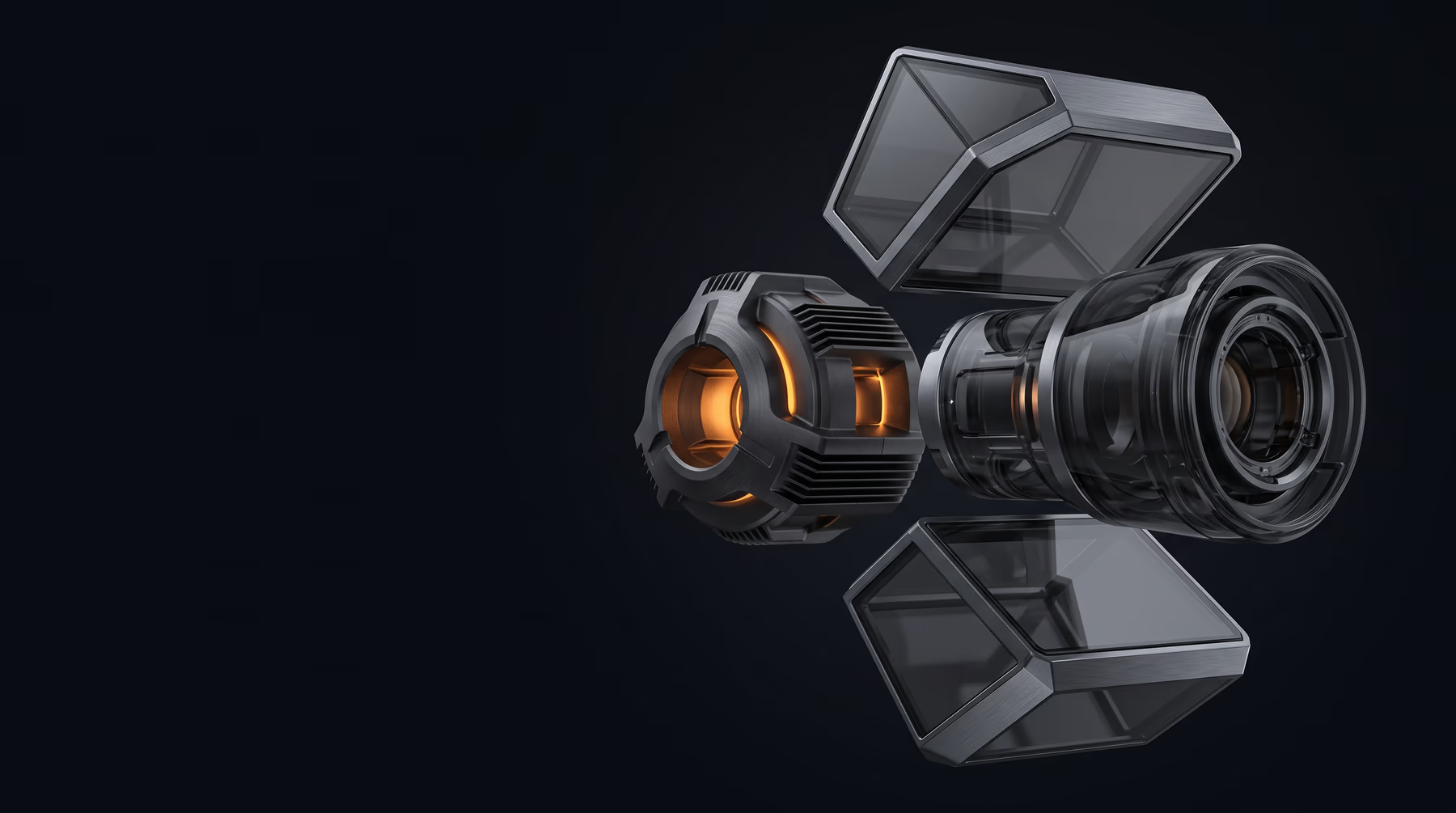
The foundation
Barion Core
Ingestion, reasoning, policy and delivery, with logging and evaluation across all of it. Every product inherits the same controls, so improvements to safety and observability reach all of them. How it is structured.
- Live
Signal intelligence for the Pakistan Stock Exchange
- In development
Assistive intelligence for clinical decisions
- Coming soon
Controlled agents that do bounded operational work
Beyond our own products
The longer-term direction is products built on Barion Core by people who own the domain. We supply the architecture, the guardrail patterns and the production engineering; the partner supplies the judgement that makes the decision correct. How that works.
Work with us
If you are operating somewhere that a wrong answer is expensive, and you would rather have a system that can explain itself than one that impresses, we should talk.